

Whether you are an early-stage growth company or a mature vendor looking to build and grow your ecosystem as a strategic growth strategy, if you are only focused on your internal processes, program KPIs, and executive alignment, you might still be "doing it wrong." I'm not suggesting those topics are unimportant — they're getting a lot of attention for good reasons. But stay with me for a few minutes.
Time, resources, attention
Partnerships take time, resources, and attention from both your organization and the prospective partner's. Let's start with the basic blocking and tackling that most partner managers have to do to build their ecosystem. It looks something like this flow (left to right). Your sequence might be different, but generally this is how partner teams build/expand their ecosystem or replace underperforming partners.

The problem? How many partners have you used this process with, only to get a big fat nothing for ARR? Or if you're an ISV, how many times have you had a service provider come to the account-mapping stage with their catcher's mitt out — "where's my leads?" Or it took months to get the first opportunity in the pipeline and the people who went through onboarding are long gone, onto other customers, or worse, working with a competitor on a project. If your team is doing even the most basic reporting and auditing of your ecosystem, you'll find a very small % are performing well.
After 12+ years on the service-provider side and the last 15 years working with partners at ISVs, I have found that both parties are coming to the table with the wrong expectations and investing time in some of these activities prematurely. I've seen many partner teams make these mistakes — including myself.
So where does this flow go wrong? First is a bit tactical, but in my opinion, don't waste time prematurely negotiating a partner agreement. The joint value prop is completely unproven. So use a simple MNDA / confidentiality agreement as the first milestone into the partner program. No redlines, no promises or commitment… yet.
I've also found that both parties usually get optimistically excited ("happy feet") after a partner agreement is executed. The partner and partner manager spend valuable time doing lots of account mapping, targeting, trying to sales-enable both teams, and maybe even co-marketing / demand gen.
So why doesn't this work? This is also premature, in my opinion, because the partnership doesn't have anything to sell yet. The ISV can't introduce the service provider to a prospect, because it's an unproven three-way relationship. The customer hasn't used the ISV, the partner hasn't implemented the ISV's product, and the customer hasn't worked with the partner. Risk all over the place. If you've tried this, you know how it goes. Be honest — you've done it and then not seen satisfying results! We all have. Usually everybody loses.
What's worse is when you've also already gotten sales teams excited about this partnership and an AE is brokering this three-way relationship on a deal… then loses because he couldn't provide ISV-partner-relevant case studies or references. That will kill your internal credibility in a heartbeat.
When I've seen this happen, both sales teams quickly write off the partnership. Somebody tried it, it didn't work, we lost a deal… moving on.
Instead, the early onboarding of a partner needs to focus on Activation and "First Deal" identification. The process that I've found to have a much higher probability of driving joint pipeline success — and laying the foundation for a longer-term partnership — looks more like this:
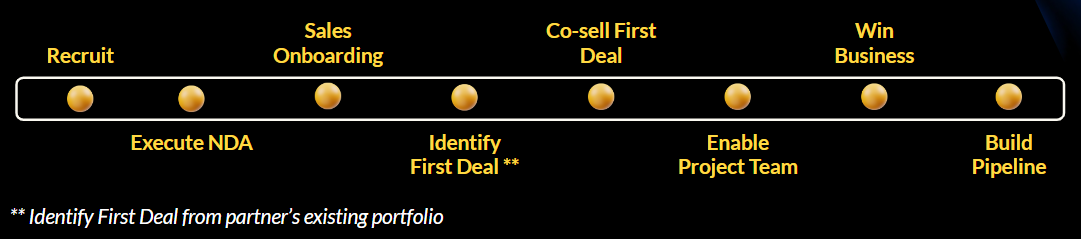
This might seem subtle, but the ** footnote is key. Up to that point, neither party has invested significant Time or Resources. And there is only a small group whose Attention is retained and who is looking for the customer who already trusts them. The ISV → Provider risk is reduced dramatically when the customer already trusts the provider. Focusing on the partner sourcing the first deal also ensures that when Time & Resources are spent on enablement, it's the actual team whose Attention will be highly focused on that first deal.
Of course this process looks a little different with ISV-to-ISV partnerships, but the principles are the same. You have to first find validation of the partnership and/or integration before trying to scale the partnership. In these situations, it could be as simple as consulting both customer success teams to identify an existing customer who has requested this partnership / integration.
Your results may vary. Leveraging this change in focus toward First-Deal sourcing has dramatically improved the success rate and activation of partnerships I've been involved with, and produced much better long-term results.